
Machine Vision for Operational Monitoring: Giving Software a View of the Physical World
Operational software is very good at recording what should happen.
A point-of-sale system records what was sold. An inventory platform records what stock should remain. A facilities platform assigns cleaning tasks. A food safety system records checks. An operations platform tracks whether a process was completed.
What these systems usually cannot do is independently observe the physical environment.
They know the process, the expected state and what somebody entered into the system. But they often cannot see whether the physical world actually matches that record.
That gap is where machine vision is becoming increasingly useful.
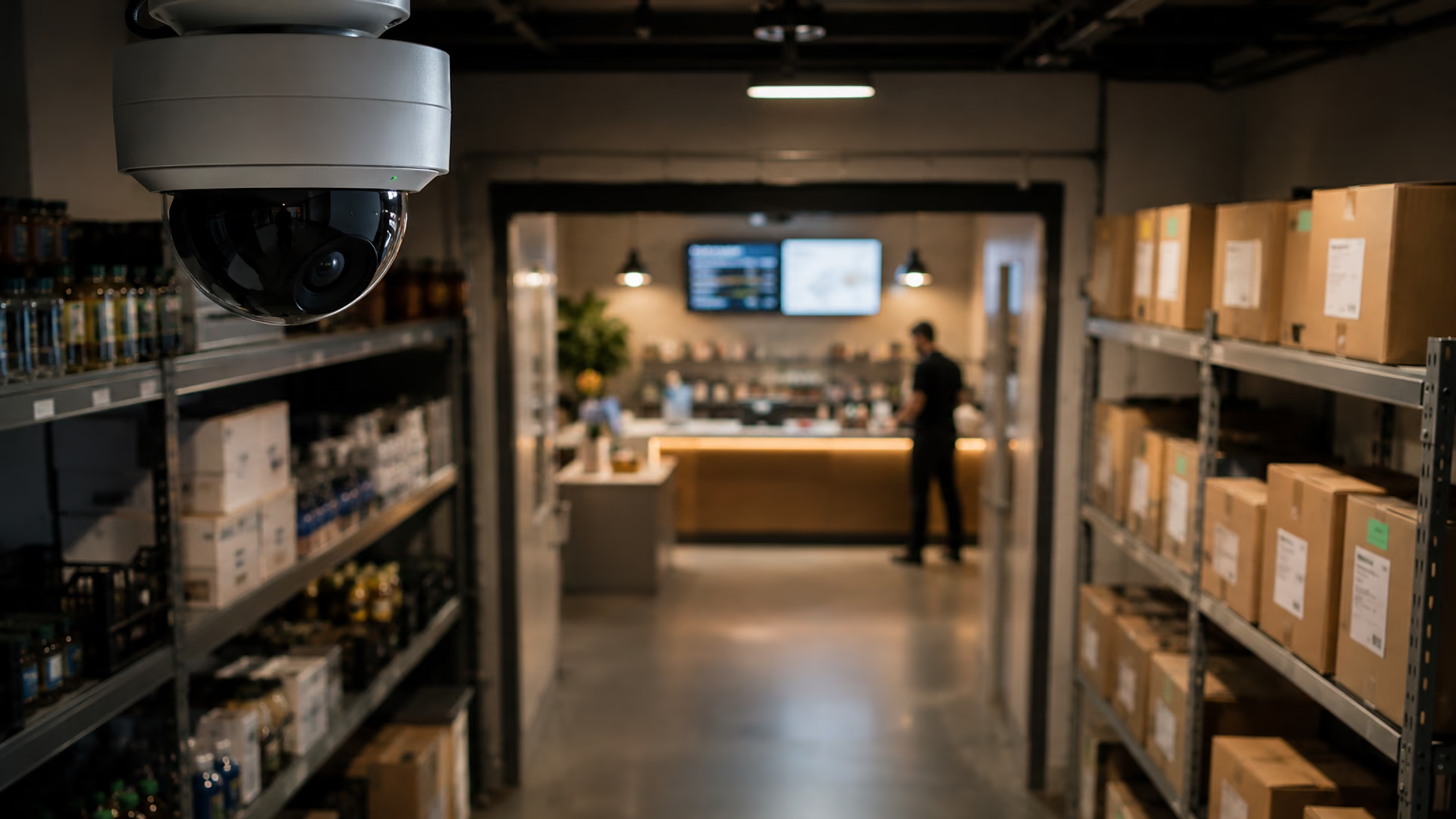
Rather than treating cameras purely as security devices or image-capture tools, businesses can use them as operational sensors: a way of turning what is physically happening in a store, warehouse, kitchen, facility or production environment into structured data that software can use.
The opportunity is not simply to recognise objects. It is to give operational systems a reliable view of the physical world.
The missing signal in operational software
Most business systems rely on digital events.
A transaction is completed. A task is checked off. A number is entered. Inventory is moved from one location to another. A worker confirms that something has been inspected.
In many cases, those records are perfectly accurate. But the software itself has no independent way of verifying them.
Take inventory. If ten units are received and three are sold, the inventory system knows that seven should remain. What it does not necessarily know is whether seven units are actually sitting in the storage area.
Products can be misplaced. Items can be moved without being recorded. Counts can be wrong. Damaged products may still exist in the system. In regulated environments, even small discrepancies can create significant operational work.
The same gap appears elsewhere.
A cleaning task may be marked as complete, but the system cannot see whether the area is actually clean. A refrigeration check may be entered into a form, but the system cannot independently confirm what was displayed on the unit at that moment. A product may be expected at a particular workstation, but the system cannot see whether the correct item is physically there.
These are all versions of the same problem.
The digital system contains an expected state. The physical environment contains the actual state. Somebody still needs to connect the two.
Traditionally, that somebody has been a person.
Machine vision provides a physical observation
Machine vision introduces another source of operational data.
A camera can observe the environment and AI can convert that observation into information that existing systems can understand.
Sometimes that is as simple as identifying a product. In other cases, the system may need to count several items, compare the current condition of a location with a reference image, or read text and numbers from a display.
The important shift is that the image is not the end product.
The image becomes evidence used to answer an operational question.
Instead of simply asking, “What is in this image?”, the workflow can ask, “Does what we can see match what the operation expects?”
That is a much more useful question for most businesses.
Inventory is a good example because the difference between the system record and the physical environment is easy to understand.
A business may already have excellent barcode scanning, POS and regulatory systems. Those systems can track every known movement. But there may still be a requirement to physically recount what remains.
This is particularly important in secure or regulated environments where inventory may need to be reconciled frequently.
A machine vision workflow can provide an independent observation of that inventory. A camera captures a storage area, the system uses visual recognition, label reading and counting to establish what is physically present, and that result can then be passed into the organisation’s existing inventory process.
The vision system does not need to replace the POS or inventory platform. Its job is to provide the physical observation those platforms do not have.
The same principle applies in less regulated environments. Warehouses, retail back rooms, industrial parts stores and distribution operations all encounter situations where the system says one thing and somebody eventually has to walk over and check what is actually there.
Machine vision can reduce how often that confirmation needs to be performed manually.
Verifying conditions, not just completed tasks
Other operational workflows are less about inventory and more about condition.
A business operating hundreds or thousands of physical locations may have detailed procedures for how those locations should look and operate. Staff may be responsible for cleaning a kiosk before opening, ensuring that a display is correctly presented or checking that equipment is ready for use.
Traditional workflow software can tell someone what to do and record that they said they did it.
Machine vision can add another layer.
A current image can be assessed against an expected condition or reference. That can help determine whether the location is actually ready, rather than simply whether the task was marked as completed.
The distinction matters.
Machine vision is not necessarily replacing the workflow. It is giving the workflow an independent source of evidence.
That same approach can be applied to information that is already visible in the physical environment but still needs to be manually entered into software.
Temperature displays are a simple example. A worker may currently walk to a refrigeration unit, look at the display and write the value into a log or enter it into software. A vision-based workflow can support the same process by capturing the display, extracting the visible value and applying the relevant operating rule.
The output is no longer just an image. It becomes a structured result that can be stored, reviewed or used to trigger another action.
The same concept applies to labels, gauges, serial numbers, product markings and other visual information that sits outside an organisation’s digital systems.
This is an important part of operational machine vision because many businesses do not need a completely autonomous system on day one. They need a more reliable way of converting physical observations into digital records.
The camera does not need to watch everything
One of the biggest misconceptions around operational machine vision is that it requires continuous video analysis.
In many environments, it does not.
The more useful question is when the physical state of the operation actually needs to be verified.
For an inventory room, that may be after somebody enters or leaves. For a kiosk, it may be before opening or after a cleaning task. For a storage area, it might be once every hour. In production, it could be when an item reaches a particular stage.
This changes the economics of machine vision significantly.
Instead of processing thousands of unnecessary frames, the system can capture images when an operational event creates a reason to inspect the physical state.
The camera becomes a sensor that responds to a business question.
Has something changed? Is the correct item present? Does this match the expected condition? How many items remain? Has the required standard been met?
This event-driven approach can reduce infrastructure, image volume and processing cost while still providing the visibility the operation needs.
It can also make deployment simpler.
In some cases, the trigger may come from a permanent IP camera. In others, it may come from a mobile device. A worker could scan a QR code at a site, open the required workflow and capture the evidence immediately.
The right capture method depends on how often the question needs to be answered and how automated the process needs to become.
Start with the workflow, not the camera
Machine vision projects often begin with a hardware question.
Where should the camera go? What resolution do we need? Should this run continuously?
Those questions matter, but they should come later.
The first question should be what operational decision the business is actually trying to make.
If the goal is to verify a site once before opening, installing a permanently streaming camera may be unnecessary. If the goal is to understand a secure inventory area after every access event, a fixed camera may make much more sense.
If the workflow only happens a few times per day, a mobile app may be the fastest way to validate the concept before introducing permanent infrastructure.
Starting with the workflow allows businesses to prove whether the visual signal is useful before optimising the capture method.
It also creates a natural deployment path.
A workflow can begin with employee-captured images. If the process proves valuable and the organisation wants greater automation, the same operational logic can then move towards fixed cameras and event-triggered capture.
The intelligence remains focused on the business problem rather than the device.
Why this matters at scale
Small manual checks become large processes surprisingly quickly.
Imagine a verification task that takes five minutes.
At one location, once per day, that is negligible. Across 500 locations, the same task represents more than 15,000 hours of work each year. Across 3,000 locations, even a very small routine inspection can become a significant operational process.
The challenge is not only labour. It is consistency.
Different employees interpret standards differently. Managers cannot review every location. Manual records are difficult to independently verify. Problems may only become visible after they have already affected customers or operations.
Machine vision creates the possibility of treating routine visual checks differently.
When the observed condition matches the expected condition, the process can continue. When it does not, the system can create an exception.
This allows people to spend more time investigating the things that are wrong instead of repeatedly confirming everything that is right.
That is a much more realistic objective than trying to remove people from operations entirely.
Machine vision is more than object recognition
Computer vision has traditionally been associated with individual AI tasks such as object detection, product recognition, counting, OCR and visual inspection.
Each of those capabilities is useful on its own.
But the larger opportunity emerges when they can be combined.
An inventory workflow might require label reading, recognition and counting. A site inspection might require comparison against a reference condition and confirmation that specific objects are present. A compliance workflow might need to extract a visible value and evaluate it against a business rule.
The operational value comes from connecting the visual capability to the workflow around it.
The camera creates the observation. The AI interprets it. The business context determines what should happen next.
That is the difference between using machine vision as an isolated recognition tool and using it as part of operational software.
Existing systems remain the system of record
Machine vision does not need to replace the software organisations already depend on.
In most cases, it should not.
The POS should remain the system of record for transactions. The inventory platform should remain the system of record for stock. The facilities platform should continue managing tasks. The compliance system should continue storing the relevant operational records.
Machine vision adds something those systems have traditionally lacked: an independent view of the physical environment.
That information can then feed into the workflow that already exists.
This is particularly important for enterprise deployments.
Businesses do not want another isolated dashboard showing interesting AI results. They want a visual observation to become useful operational data.
If a discrepancy is detected, another system may need to receive it. If a condition fails, somebody may need to be notified. If the result is correct, the workflow may simply close automatically.
The vision component becomes part of the operational architecture rather than another standalone tool.
The next operational data source is visual
Businesses have already digitised most of the events that happen inside their software.
The next challenge is capturing what still happens outside it.
Products sitting in storage. Equipment displays showing physical values. Locations being cleaned and prepared. Items moving through operational environments. Visual standards being met or missed.
Historically, organisations have collected that information through people.
Someone looks, counts, reads, checks and records.
Machine vision gives businesses another option.
It allows cameras to become operational sensors and turns visual observations into data that existing systems can act on.
That does not mean analysing every camera feed continuously. It does not mean replacing every employee performing an inspection. And it does not mean replacing the systems that already run the business.
It means giving those systems something they have rarely had before: a view of what is actually happening in the physical world.
Operational software already knows the process.
Machine vision can help it see the reality.
If you have a physical check that somebody still performs by eye, we can look at it with you.