
Vision AI in Production: Why Vision Models Alone Don’t Work
Most teams can access powerful image models. The challenge is turning them into reliable, fast, and cost-effective workflows that actually run in production.
What “Vision AI in production” actually means
Vision AI in production refers to using image analysis systems inside real workflows, where outputs must be reliable, fast, and structured for decision-making.
This is where most implementations break down.
The problem isn’t access to image models
Teams are increasingly integrating vision AI into real workflows:
- verifying deliveries from photos
- checking cleanliness after a job
- detecting damage
- counting items against expected lists
On the surface, this looks straightforward: take an image model from OpenAI, Google, or Microsoft, plug it into your system, and start analysing images.
In practice, this is where things start to break.
Vision AI models are widely available, but production-ready systems require structured workflows, not just model outputs.
Where vision AI breaks in production
When teams integrate a vision AI API directly, a few challenges show up quickly:
1. Inconsistent performance across environments
Lighting, angles, and real-world variation introduce noise that benchmark datasets don’t capture.
2. One model doesn’t fit every task
A model that is strong at counting might struggle with damage detection. A model that detects issues might not validate against a checklist reliably.
3. Outputs aren’t usable in workflows
Most models return descriptions or loosely structured responses, not something you can plug directly into a system.
4. No control over latency, accuracy, and cost
These trade-offs matter in production, but raw model APIs don’t help you optimise across them.
The model landscape is expanding fast
Providers like OpenAI, Google, and Microsoft offer powerful image analysis capabilities.
On top of that, there are hundreds of open-source and proprietary vision models, from providers like Meta Platforms and newer model families such as Qwen, each with different strengths and trade-offs.
This landscape is evolving rapidly. New versions, updated checkpoints, and improvements are released constantly, often changing performance and making results harder to reproduce over time.
The number of capable models is growing rapidly. The challenge is no longer access, but how to use them effectively.
Not every image analysis task should be handled the same way
Some image models can handle tasks end-to-end.
But this doesn’t hold consistently across all use cases.
The same setup that works well for one task can degrade in another or under different conditions.
Two ways vision AI workflows are executed
1. Single-model execution
A model handles the task in one pass.
Works well when:
- the task is simple
- the environment is controlled
2. Multi-step workflows (agent chaining)
More complex workflows require multiple steps:
- detect objects
- count items
- validate against expected inputs
- check for issues
Each step is handled separately, then combined into a final result.
This approach is more reliable when:
- multiple checks are required
- accuracy matters more than simplicity
- edge cases need to be controlled
(We covered this in more detail in an earlier post on Agent Chaining.)
Small changes have a big impact
Even when using the same model, small changes can significantly affect results:
- how the task is structured
- how the model is configured
- how outputs are interpreted
These directly impact:
- latency
- consistency
- cost
The challenge is not access to models, but making them reliable under real-world constraints.
What production-ready vision AI looks like
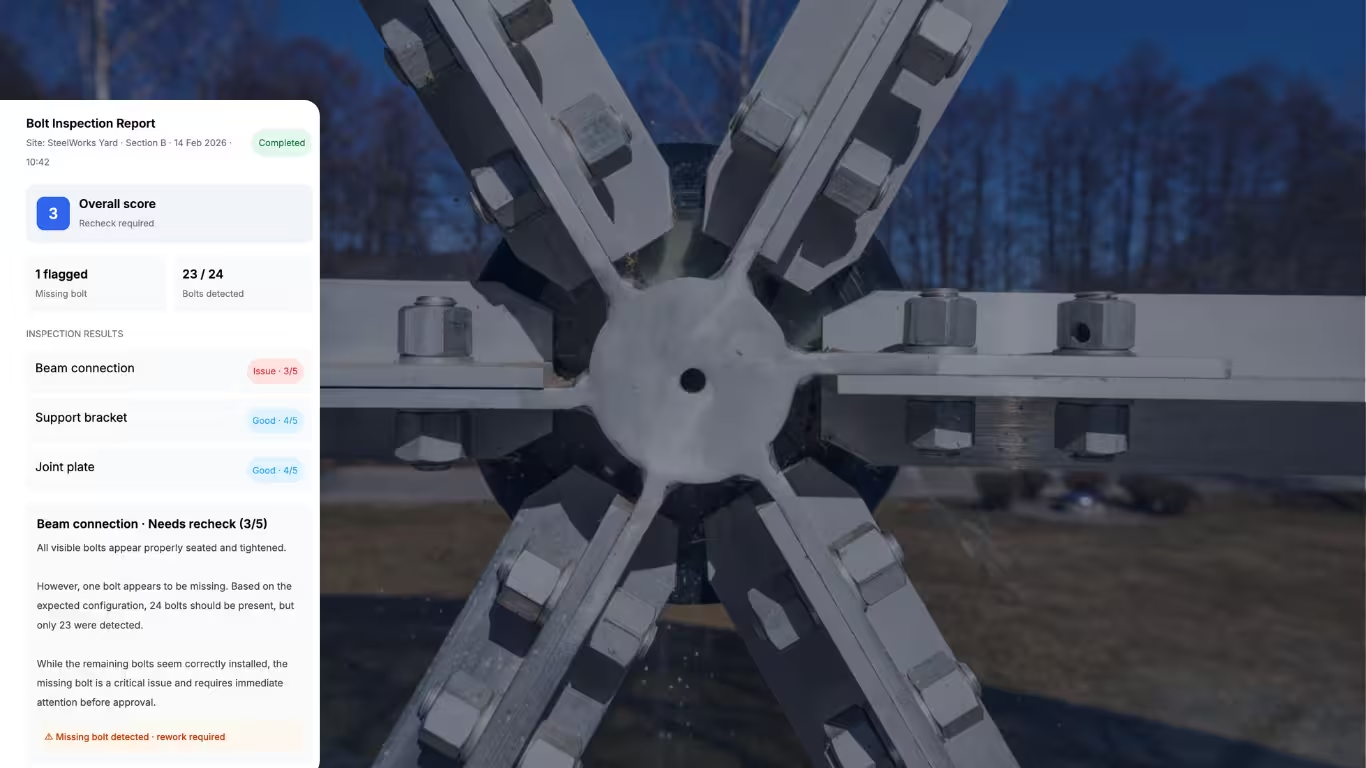
Instead of returning raw outputs, production systems return structured results:
- item counts
- validation against expected inputs
- detected issues such as damage or cleanliness
- pass/fail outcomes
This is the difference between:
- model output
- operational output
From image models to integration
All of this only matters if it is easy to use.
For most teams, the challenge is not analysing images. It is integrating vision AI into existing systems.
Instead of building everything from scratch, each Vision Agent is exposed as a single API endpoint.
You send an image. You get back a structured result.
How developers use this in practice
Through the developer hub and the Tiliter Platform each agent can be:
- tested instantly in the browser
- validated using real images
- integrated via a single endpoint
This allows teams to move from:
- idea → testing → production
without building their own vision AI infrastructure.
The complexity sits behind the API, not in front of it.
The real constraint: latency, accuracy, and price
Every production system comes down to three things:
Latency Can it run fast enough for real workflows?
Accuracy Does it perform on real-world data?
Price Can it scale economically?
The goal is not to maximise one, but to balance all three.
Key takeaways
- Vision AI models are easy to access but hard to operationalise
- Real workflows require structured outputs and multi-step logic
- Performance depends on balancing latency, accuracy, and cost
- The main challenge is execution, not model access
Final thought
Vision AI models are improving rapidly.
Access is no longer the bottleneck.
The real challenge is making them:
- reliable
- fast enough
- cost-effective
- usable in production systems
That is where the difference is made.
Not in the model itself, but in how it is configured, structured, and delivered into real workflows.