
PPE Compliance Verification: From Policy to Proof
Walk onto most industrial sites and you will find a safety induction process, a PPE policy, and a sign-in sheet confirming that workers have read and understood the requirements.
What you will not usually find is reliable evidence that the required PPE was actually worn when the work took place.
That gap becomes visible after an incident, during an audit, or when an insurer asks for proof of compliance. Organisations can often demonstrate that workers were told what PPE to wear. Demonstrating what was actually worn at a specific time and place is much harder.
A policy is a promise. A photo is proof.
The problem with traditional PPE compliance
Most PPE compliance processes rely on a combination of inductions, toolbox talks, supervisor walkthroughs, and paper or digital checklists.
These processes are important, but they have a limitation.
They verify that PPE requirements were communicated. They do not verify that the required PPE was being worn when the work happened.
A worker may sign a form confirming they understand the rules. A supervisor may conduct a spot check at the start of a shift. Neither creates evidence that a hard hat, hi-vis vest, gloves, eye protection, or harness were present during a specific task hours later.
When an incident occurs, organisations often discover there is a significant difference between:
“Workers were instructed to wear PPE.”
and
“This worker was wearing the required PPE at this exact time and location.”
The cost of that gap is rarely the PPE itself. It is the investigation, dispute, insurance claim, liability exposure, downtime, and administrative effort that follows.
Turning PPE compliance into operational verification
The solution is not another induction module or another form.
The solution is changing the definition of compliance.
Instead of treating compliance as a declaration, organisations can treat it as a verification process.
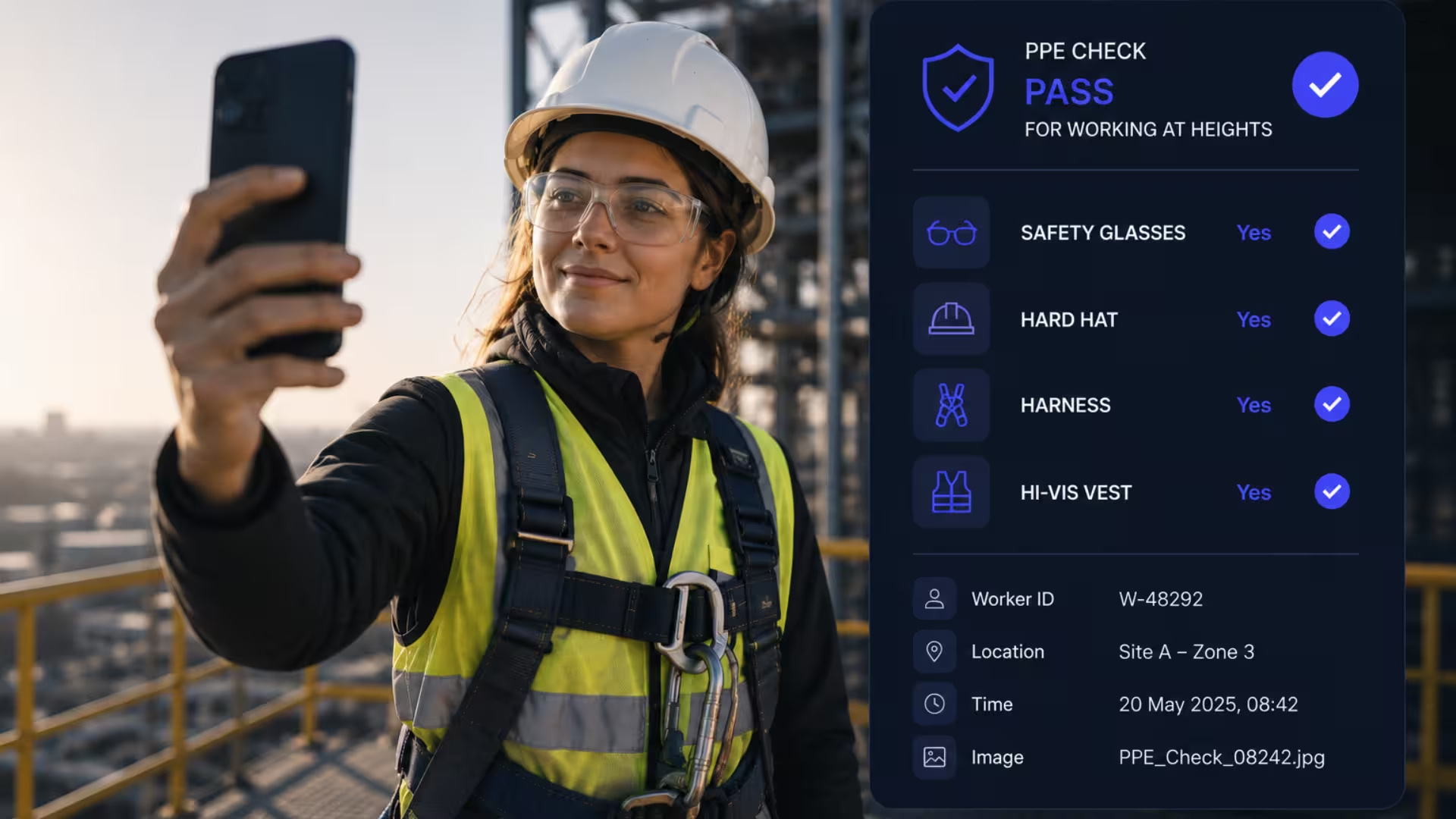
Before a high-risk task begins, a worker captures a photo using the device they already carry. A Vision Agent automatically checks the image against the PPE requirements for that task.
The system can verify whether:
- A hard hat is present
- A hi-vis vest is being worn
- Gloves are visible
- Eye protection is present
- A harness is being used where required
- Other task-specific PPE requirements have been met
The result is a structured record containing:
- The image
- The pass or fail result
- The reason for the result
- The worker
- The location
- The time of verification
Instead of relying on assumptions, organisations gain evidence.
What this looks like in practice
Imagine a contractor arriving on site to perform a maintenance task involving elevated work.
Before the task begins, the worker receives the work order and PPE requirements on their device.
As part of starting the task, they take a photo.
A Vision Agent evaluates the image against the PPE requirements for that activity. If the required equipment is visible and correctly worn, the check passes automatically. If something is missing, the worker is notified immediately so it can be corrected before work begins.
The entire process takes seconds.
Supervisors no longer need to physically inspect every worker before every task. Safety managers gain visibility across multiple locations without relying exclusively on periodic walkthroughs. Auditors and insurers receive evidence that PPE compliance was checked at the point of work rather than assumed after the fact.
Most importantly, organisations move from documenting intentions to documenting reality.
Doesn’t this create more paperwork?
In practice, it often reduces it.
Many teams already capture photos to document work conditions, site readiness, equipment status, or completed tasks. The difference is that those images are rarely reviewed consistently and often remain buried in folders.
With automated verification, the image is checked immediately against a predefined standard and the result is recorded automatically.
Instead of creating additional forms, organisations can often remove manual compliance checks, supervisor sign-offs, or end-of-shift verification processes.
The photo becomes the evidence.
What about old photos or incorrect images?
This is a common concern.
A photo from yesterday should not become evidence for today’s task.
Verification can incorporate contextual information such as the time of capture, location, user identity, workflow assignment, and the contents of the image itself.
If the required PPE is not clearly visible, the verification fails.
If the image does not show the correct worker or work area, the verification fails.
The standard is applied consistently regardless of who submits the image.
PPE is only one use case
While PPE compliance is an obvious application, the same verification model applies to many operational workflows.
Organisations already capture photos for:
- Site inspections
- Equipment condition checks
- Delivery verification
- Housekeeping audits
- Cleanliness inspections
- Asset verification
- Maintenance activities
- Quality assurance processes
The challenge is that someone still needs to review those images manually.
Vision Agents automate that review process.
Instead of collecting photos and hoping somebody checks them later, organisations can verify requirements immediately and generate structured records automatically.
The goal is not PPE detection.
The goal is operational verification.
PPE compliance is simply one example of how image-based evidence can replace assumptions.
Where to start
You do not need to verify every task on day one.
Start with the highest-risk activity on your site. Choose the workflow that would trigger the most serious investigation if PPE requirements were not met.
Run photo-based verification for that single workflow for two weeks.
Compare the resulting records with what your existing sign-off process would have provided during the same period.
For many organisations, that comparison alone is enough to demonstrate the difference between documenting compliance and proving it.
See it on your own images
Upload site photos and see how a Vision Agent verifies PPE requirements against a predefined standard.
No model training. No custom development. No complex setup.
Test it on your own images or speak with the Tiliter team about building a verification workflow for your sites and operations.
Frequently Asked Questions
What is PPE compliance verification with Vision AI?
It is the process of confirming from a photo that a worker is wearing the PPE required for their task and location. A Vision Agent evaluates the image against a predefined standard and returns a pass or fail result supported by evidence.
How is this different from a safety checklist or induction record?
Inductions and checklists confirm that PPE requirements were communicated and acknowledged. They do not confirm what a worker was wearing at the time of the task. Photo verification evaluates what is actually visible in the image.
What PPE items can be checked?
Common examples include hard hats, hi-vis clothing, safety glasses, gloves, hearing protection, and fall-arrest equipment. Requirements can vary depending on the task and site.
Do workers need special equipment?
No. Verification works with the smartphones, tablets, scanners, and cameras organisations already use.
What records are available for audits?
Each verification produces a structured record containing the image, the result, the reason for the result, the timestamp, the location, and the worker associated with the task. These records can be used during audits, insurance reviews, and incident investigations.