
How to Prove Cleaning Was Completed With Photo Evidence
Cleaning services are often evaluated based on trust. Supervisors sign checklists, contractors report completed tasks, and facility managers assume the work was done properly.
But when complaints arise, proving that cleaning actually happened becomes difficult.
Without objective evidence, disagreements between clients, contractors, and facility managers are common – especially in environments with multiple locations, rotating teams, or outsourced cleaning providers. In large organisations, cleaning operations are typically managed within broader facility management programs, which oversee building operations, safety, and workplace services across multiple sites.
Photo verification offers a practical way to confirm cleaning work and create a reliable record of service.
Key Takeaways
- Cleaning checklists confirm tasks but do not prove the actual result.
- Photo evidence creates an objective record of cleaning work.
- Manually reviewing inspection photos does not scale across multiple sites.
- AI-based image analysis can evaluate cleanliness automatically and generate structured reports.
Why Proving Cleaning Work Is Difficult
Most cleaning verification processes rely on manual documentation.
Typical methods include:
- paper checklists
- supervisor walkthroughs
- digital task lists
- written reports
These methods confirm that tasks were assigned or signed off, but they do not prove the actual condition of the cleaned area.
Two common problems appear.
Lack of visual evidence
A signed checklist cannot demonstrate that a bathroom, corridor, or workspace was actually cleaned.
Subjective inspections
Even when supervisors perform inspections, judgments about cleanliness vary from person to person.
This makes it difficult to resolve complaints or maintain consistent quality across sites.
The Limitations of Traditional Cleaning Checklists
Checklists are useful for organising tasks, but they rarely provide reliable verification.
A checklist typically answers:
- Was the task scheduled?
- Was the task marked as completed?
It does not answer:
- What did the area actually look like?
- Was the cleaning standard met?
- Were any issues visible after cleaning?
When a dispute occurs, facility managers often have no objective record to review.
Why Photo Evidence Improves Cleaning Verification
Capturing photos during or after cleaning creates a visual record of the work performed.
Instead of relying on written reports, organisations can document the condition of the space at a specific moment.
Photo verification provides several advantages.
Objective documentation
Images show the actual condition of the cleaned area.
Time-stamped evidence
Each image can be linked to the time and location of the inspection.
Transparency for clients
Clients can review the evidence rather than relying on written summaries.
Operational accountability
Teams know that work is verified through visible results.
However, as operations grow across multiple locations, reviewing thousands of inspection photos manually becomes difficult.
Most cleaning inspection platforms allow photos to be uploaded as part of a report, but the images are rarely analysed. Supervisors still need to review them manually, which becomes time-consuming and inconsistent at scale.
Turning Photo Documentation Into Photo Verification
Inspection photos are valuable evidence, but only if someone actually reviews them.
In many organisations, photos are stored as documentation rather than used as part of a structured verification process.
When operations span dozens or hundreds of sites, manually reviewing every inspection image quickly becomes impractical.
This is where image analysis becomes useful.
Instead of relying entirely on human interpretation, vision software can automatically analyse inspection photos to evaluate visible cleanliness conditions.
This turns inspection photos from passive documentation into structured verification data.
Using AI to Verify Cleaning Quality
Most cleaning inspection systems allow teams to upload photos as part of a report. However, these images are typically stored as documentation and reviewed manually.
AI cleanliness evaluation takes a different approach.
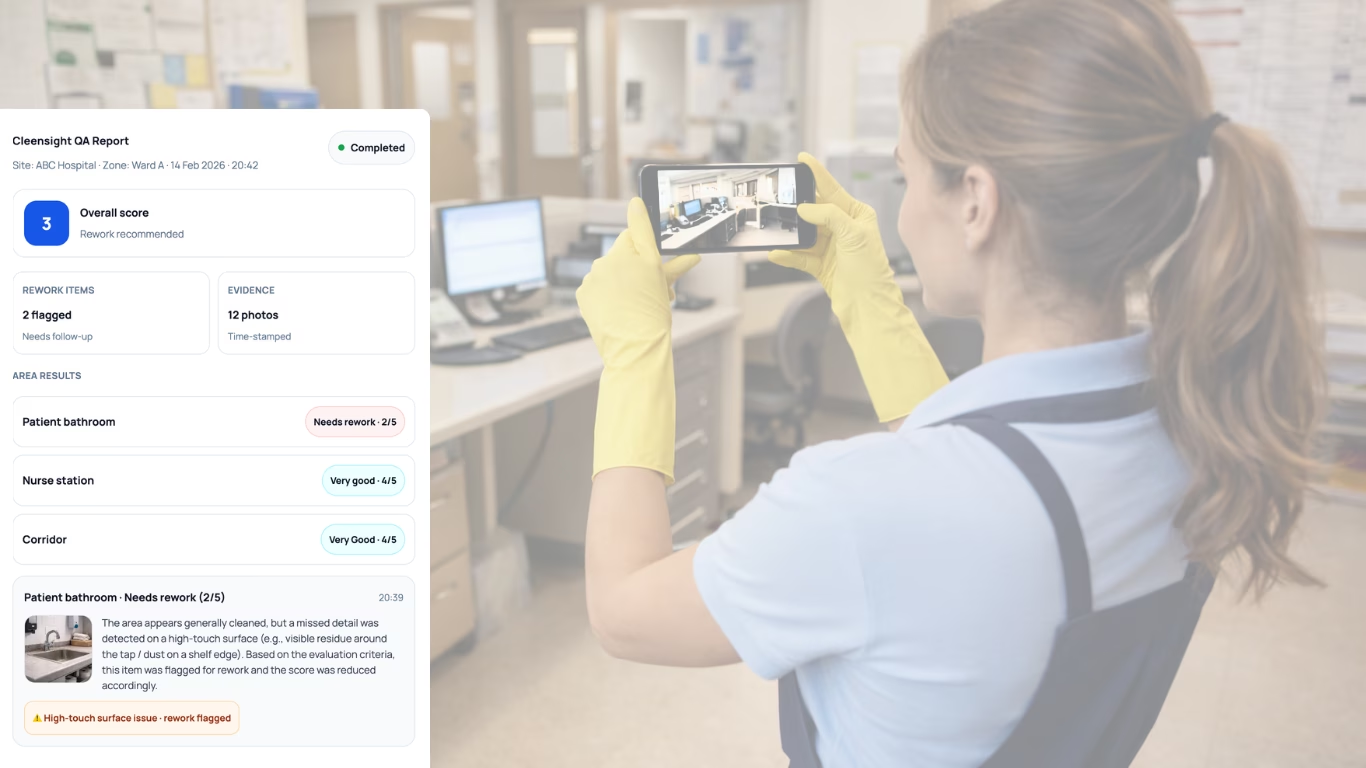
Instead of simply storing inspection photos, the evaluator analyses them to assess visible cleanliness conditions such as debris, residue, spills, or surface marks.
For example, the system can:
- detect visible dirt or debris
- identify areas that may require additional attention
- generate a cleanliness score
- flag areas that may require rework
The result is a standardised inspection process that produces objective records of cleaning performance.
Each inspection creates:
- photo evidence
- a time-stamped record
- a cleanliness score
- structured documentation that can be shared with supervisors or clients
This approach helps organisations generate audit-ready cleaning reports without requiring supervisors to manually review every inspection image.
How AI Turns Inspection Photos Into Cleaning Proof
An AI cleanliness evaluator assesses each inspection photo against the standard the site has set.
The process is simple.
1. Capture a photo
Cleaning teams take a photo of the area using a smartphone as part of their normal workflow.
2. AI evaluates the image
The evaluator analyses the image to assess visible cleanliness conditions and generate a score.
3. Generate a structured report
The system records the results and produces a structured inspection report including images, timestamps, and scoring results.
These reports provide clear proof of cleaning quality and can be used for:
- internal QA checks
- contract reporting
- dispute resolution
- operational improvement
Instead of relying solely on checklists or supervisor opinions, organisations gain objective evidence of cleaning performance.
Where Photo-Verified Cleaning Is Most Valuable
Photo-verified inspection records are particularly useful in environments where multiple teams, locations, or contractors are involved.
Examples include:
- commercial office cleaning
- hospitals and healthcare facilities
- retail chains and supermarkets
- hotels and hospitality environments
- public facilities such as airports or transport hubs
In these environments, visual verification helps ensure that cleaning standards remain consistent across locations. Many organisations use structured frameworks such as the APPA cleanliness levels to define inspection criteria.
Creating Reliable Proof of Cleaning
Proving cleaning performance requires more than task checklists or written reports.
Visual documentation combined with structured verification provides a more reliable approach.
By capturing inspection photos and analysing them consistently, organisations can create:
- objective evidence of work performed
- clear inspection records
- consistent quality standards across sites
This approach helps reduce disputes, improve accountability, and provide clients with transparent proof of service.
FAQ
How can you prove cleaning was completed?
Traditionally, cleaning has been verified using supervisor inspections, checklists, or photos taken during walkthroughs. These methods rely on manual review and subjective judgment. AI cleanliness evaluation introduces a different approach by analysing inspection photos automatically and generating objective cleanliness scores and structured verification records.
What is photo verification of cleaning?
Photo verification involves capturing images of a cleaned area to document its condition after a cleaning task. In most operations these photos are simply stored as documentation. An AI evaluator analyses inspection photos to assess visible cleanliness conditions and generate a structured verification record.
Why are cleaning checklists not enough?
Checklists confirm that tasks were scheduled or marked as completed, but they do not show the actual condition of the cleaned space. Without visual evidence, it is difficult to verify whether cleaning standards were met or resolve disputes about service quality.
What is AI cleanliness scoring?
AI cleanliness scoring is a different approach. Instead of relying on manual inspections, the evaluator analyses inspection photos and evaluates visible cleanliness conditions such as debris, spills, or residue. The system generates a consistent cleanliness score and creates a structured inspection record.
Putting this into practice
If you want the assessment itself – an image read against your own standard, with the findings attached – that is the AI cleanliness evaluator. If you need the process around it, assigning the check and keeping the trail, that is the cleaning audit workflow.